
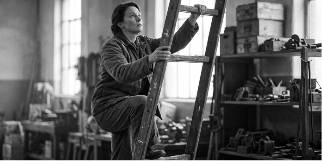
The Rung That Was Never Broken
Women aren't falling off a ladder. We were handed one with a rung missing from the start, and the data, finally, proves it.
Every March, the world holds a brief, well-lit ceremony for women. We get a day, a hashtag, a round of applause that lasts approximately until the quarterly results come out, at which point the conversation pivots back to productivity, profit margins, and why the talent pipeline keeps producing the same demographic at the top. I have been in that pipeline and I have also been spat out of it. Hospitalised by it, and eventually rebuilt something entirely outside of it. So when the theme for this edition arrived in my inbox, 'From Breaking Barriers to Building Systems', I felt something sharpen in me. Because there is a question embedded in that framing that most International Women's Day coverage quietly sidesteps: what if the barriers were never accidental?
This is not a piece about resilience as a virtue. I have spoken to enough exhausted women in enough boardrooms to know that we have over-romanticised the idea of women persevering through systems that were never designed to hold them. Resilience in this sense is a response to an unacceptable environment, it is not, by itself, a strategy. This is a piece about what happens when you stop performing resilience and start engineering something different, and why the data tells us, right now in 2026, that work has never been more urgent.
The Rung
There is a phrase that has entered the lexicon of HR and leadership research over the past decade: the broken rung. It describes the point in the corporate pipeline where women first fall behind men, not at the C-suite, not at the glass ceiling, but at the very first promotion from entry level to manager. McKinsey Women in the Workplace 2025 report, the largest study of its kind across North America, found that for every 100 men promoted into their first management role, only 93 women are promoted. For Asian women and Latina women, that number drops to 82. For Black women, it drops to 60.
This is a ground-floor problem, not a glass-ceiling one, and it has now persisted for eleven consecutive years.
Eleven years. Think about what that means in practice. Every cohort of entry-level women who joined a company a decade ago and were passed over for that first management role is now mid-career, carrying the compounding cost of that early exclusion: lower earnings, less sponsorship, less visibility, smaller pensions. The pipeline did not break somewhere near the top but it was designed, consciously or not, to narrow from the very beginning.
Zoom out and the picture does not improve. The World Economic Forum's Global Gender Gap Report 2025 found that women represent 41.2% of the global workforce yet hold only 28.8% of senior leadership positions worldwide. Full gender parity is now projected to be 123 years away at the current pace. Most striking is the education paradox: women outperform men in higher education in most economies, yet only 29.5% of tertiary-educated senior managers are female. The pipeline of able women is abundant but the system is not calibrated to carry them through.
The Dismantling
In January 2025, executive orders in the United States directed federal agencies to end DEI programmes, preferences, and training. The chilling effect spread rapidly into the private sector. By mid-2025, companies including Amazon, Meta, Accenture, and Google had scaled back or quietly dismantled diversity initiatives that had taken years to build. Mentions of DEI in S&P 500 annual filings fell from an average of 12.5 times in 2022 to approximately 4 times in 2024, a figure that dropped a further 68% year on year according to The Conference Board. Goldman Sachs removed its requirement for IPO-bound corporate boards to include women and people of colour. Women's leadership programmes were reclassified as 'informal' or eliminated outright. One in six companies cut diversity staff or resources over the course of 2025.
According to the U.S. Bureau of Labor Statistics, Black women lost 38,000 jobs in April 2025 alone, with their unemployment rate rising from 5.1% to 6.1%, the highest increase of any demographic group during that period.
This is what happens to real careers, real earnings, and very real families when the infrastructure of equity gets treated as optional.
For those of us outside the United States, it would be convenient to treat this as someone else's problem, but the evidence suggests otherwise. In March 2025, European companies holding US government contracts received formal directives to align with the new US DEI requirements, prompting immediate political responses in France, Belgium and Spain. But the pressure is documented, and the lesson of the past two years is that what begins as a US policy conversation finds its way into boardrooms on every continent.
The Ambition Gap That Isn’t
In 2025, for the first time in its history, the McKinsey Women in the Workplace report found women are notably less likely than men to say they want to be promoted. 80% of women expressed a desire for advancement, compared to 86% of men. In early-career women, historically the most ambitious cohort in the entire pipeline, that figure drops to 69%, against 80% of their male peers. The predictable interpretation of this data is that something has changed in women: their confidence, their appetite, their willingness to compete. That interpretation is wrong.
The data proves women receive the same level of career support, sponsorship, and manager advocacy as men, the ambition gap disappears entirely.
It is absolutely not a women's problem but a support problem that has been misread as a motivation problem, which is precisely how structural failures tend to survive: by being attributed to the people they harm. Only 31% of entry-level women have a sponsor, compared to 45% of entry-level men. And in a finding that ought to alarm every organisation currently investing in AI capability, only 21% of entry-level women are encouraged by their managers to use AI tools, compared with 33% of men at the same level. Early AI adoption is now directly correlated with promotion and thus the broken rung is acquiring a digital dimension.
What I Learned in a Hospital Bed
I was in my early twenties, working in one of the world's largest IT services companies, performing well inside a high-pressure global sales team, and grieving the recent loss of my father. I was doing what high-performing women in high-performing environments tend to do: absorbing everything, accommodating everyone, and saying nothing about the cost. Until my body said it for me. I ended up in hospital with stress-related illness at an age when I should have felt invincible.
What I understand now, after delivering 13,000 1:2:1 coaching hours and a decade in the performance and wellbeing space, working with some of the world's largest organisations and most prestigious universities, is that what happened to me was not a personal failure of resilience. It was a predictable output of a system with no mechanism for recognising the difference between sustainable performance and performance that was quietly destroying the person producing it. I was not broken, the environment was. And when I eventually left, not in defeat but with clarity, I realised that in leaving I could address the problem at its source.
HumanOS exists because of that hospital bed and because of what I found on the other side: that the most sophisticated organisations in the world are still treating employee wellbeing as a benefit rather than as infrastructure. A gym membership, a meditation app, or worse, a fruit bowl. Meanwhile, burnout costs the global economy an estimated $322 billion annually, and senior-level women are among the highest-risk groups, reporting elevated burnout alongside fears that their gender will actively impede their advancement. These are not separate problems but the same problem wearing different clothes.
Building the System
The theme of this edition asks us to move from breaking barriers to building systems, and I want to be precise about what that means, because the phrase risks being co-opted into something inspirational but inert. A system, in the genuine sense, produces consistent outcomes regardless of whether any individual champion is present to push for them. It is structural and not dependent on goodwill.
Structural change requires three things working in concert: leadership that has made equity a business priority with teeth rather than a talking point, policy that is written into performance architecture rather than tucked into an employee handbook nobody reads, and managers who have actually been trained and held accountable to act differently. Because right now, the broken rung is maintained by ten thousand small decisions made by individuals who were never taught to see their own biases, were never held accountable for the development trajectories of their female direct reports, and were never given the data to understand that the ambition they are interpreting as absent was, in fact, never given the conditions to exist. None of those three works without the other two. The broken rung is not maintained by any one failure but by the distance between what leadership declares, what policy enables, and what actually happens in the room when no one senior is watching.
The Inconvenient Optimism
I am going to end with something that might surprise you, given everything above: I am genuinely optimistic. Not naively, not performatively, but because the data that describes the problem also describes the solution with unusual precision. We now know exactly where in the pipeline women fall behind. We know it is the first promotion, the sponsorship gap, the manager-level advocacy deficit, and now, for the first time, it is the AI support gap too. The organisations that will outperform over the next decade are not the ones that waited for the political climate to make inclusion easier. They are the ones that treated gender equity as what it has always been: a talent strategy and an operational imperative dressed up, for too long, as a values statement.
The most powerful systems are built by people who have experienced the gap from the inside. Suffering is not a problem qualification, but proximity to a problem produces a different quality of solution. You stop designing for the average and start designing for the reality, and the reality, in 2026, is that the rung was never broken but never put there in the first place. The work is not to repair it, the work is to build the whole ladder, properly, for the first time.
List of Comments
Leave a Comment