
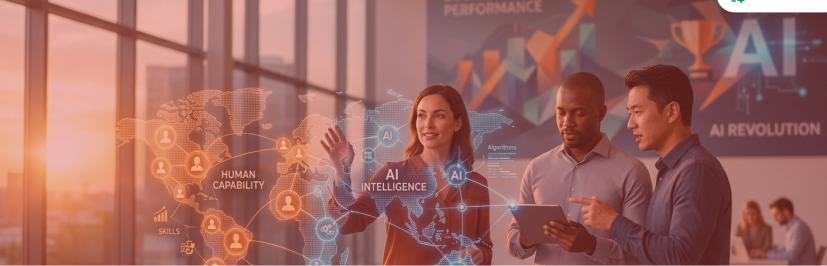
The New CHRO Playbook: Leadership Lessons, Business Impact, and the AI Revolution
What defining moments shaped your journey as a woman leader in HR?
All of us have a few of those crucible moments in our careers that reveal and shape our character as a professional. We may not recognize them as such when they are happening, but their significance can grow over time. Here I share a few of these experiences that have stuck with me through the years and have shaped me as a leader.
The Value of Mentoring - Early in my career, I had the good fortune of working for two wildly different mentors: one who excelled in relationship-building, and the other in intellect. As I observed the former’s talent for working with employees, and stakeholders, and the latter’s strategic proficiency, I came to understand the importance of playing to one’s strengths. In my case, I realized that I enjoy solving complicated problems in practical ways. I’ve enhanced this skill over the years and it has served me well in my professional life. Understand and hone your natural strengths.
Know Your Blind Spots - While it may seem counterintuitive, people skills do not always come naturally to leaders. And yet the value of building trust through interpersonal relationships cannot be underestimated. When I accepted a position as head of People, I resolved to make it a priority to connect with my new colleagues. As I worked alongside people facing development issues, listening to colleagues and accepting different points of view became essential to getting the job done. Fostering trusted relationships was one of the many positive outcomes of these exercises. Always look for opportunities to stretch yourself.
Come to the Table with a Point of View - In another chapter of my career, I found myself seated across from my CEO who was seeking my opinion. The issue at hand involved an employee who had come under criticism. When the CEO asked me how I thought we should handle the situation, I hedged my response rather than offering my honest opinion. I was immediately disappointed with myself and it was clear my boss was, too. While I had taken the diplomatic route by offering various points of view, the only one he really wanted was my own. People who respect your opinion will ask for it, so offer it with confidence.
Build a Great Team - Most leaders will agree that team-building is a priority, but it takes a considerable amount of time and work. Through the years, I’ve refined my approach to two tactics. First, I strive to hire not only exceptionally talented people but those with diverse backgrounds and experiences. And while it’s important to ask “Is this person qualified?”, I also place a premium on character: qualities such as trust and high integrity. People can learn new skills; they can’t learn character. Surround yourself with the very best people you can find.
How does HR today directly influence business growth and profitability?
Gone are the days when Human Resources was simply seen as the department handling payroll and paperwork. Today, HR plays a much more significant part in how a business performs and grows. It’s about looking ahead and making sure the people's side of the business directly supports what the company wants to achieve. This shift means HR professionals need to understand the broader business picture. They become partners with other leaders, contributing to decisions that impact the workforce and, by extension, the company’s success. It’s about being forward-thinking rather than just reactive.
The business world doesn’t stand still, and neither can your organisation. When significant changes are on the horizon, whether it’s a new system implementation, a merger, or a shift in market strategy, HR plays a vital part in making that transition smoother for everyone involved. Effective change management, guided by HR services, is about more than just announcing new policies; it’s about preparing your people. Financial literacy empowers HR to move from a support role to a true strategic business partner.
Here’s how HR contributes strategically:
Investing in your people isn’t just an HR task; it’s a smart business decision that directly impacts your bottom line and long-term success. HR can be your trusted partner in building a workforce that is not only skilled but also committed to your organisation’s goals.
A well-managed performance system means employees are aligned with the business’s direction. This alignment is key to motivation and achieving organisational goals.
Building a culture of trust and respect means employees feel safe to share ideas and take calculated risks, which is vital for innovation and problem-solving.
When organisations proactively manage change, they not only minimise disruption but also create opportunities for innovation and growth. HR’s involvement ensures that the human element of change is not overlooked, leading to better adoption rates and a more resilient workforce.
HR serves as a profit enabler, bridging human potential with business success. When HR and Finance align their objectives, the synergy yields not just operational efficiency but exponential business growth.
How is the CHRO role evolving in the AI and automation era?
In 2026, Chief Human Resources Officers are stepping into a different role entirely, one that puts them right in the middle of how companies reinvent themselves. Between AI (artificial intelligence) disrupting workflows, skills becoming outdated faster than ever, and employees expecting more from work, HR leaders need a broader toolkit than they did even a few years ago
Today’s HR leaders work directly with Chief Executive Officers and boards on business strategy. They’re involved in decisions about technology adoption, organizational redesign, and how to position the company for future growth. According to Gartner’s 2026 CHRO Priorities research, embedding culture into day-to-day work can increase employee performance by up to 34%. This change means CHROs need to think less like administrators and more like business leaders who happen to specialize in people.
This adoption creates constant disruption. Jobs are changing, skills are becoming outdated faster, and employees are anxious about what AI means for their careers. Successful AI transformation begins with alignment, not algorithms. Companies are no longer made up solely of human talent. They now operate with a mixed resource pool: humans and digital labor, employees and AI agents, all contributing to the same outcomes. First, we had to take the anxiety down from our workforce.
In this new reality, the CHRO cannot be a spectator. We must be front and centre in the AI conversation. The role of the CHRO is expanding from managing human capital to designing the total workforce architecture — where human capability and artificial intelligence complement each other.
List of Comments
Leave a Comment