
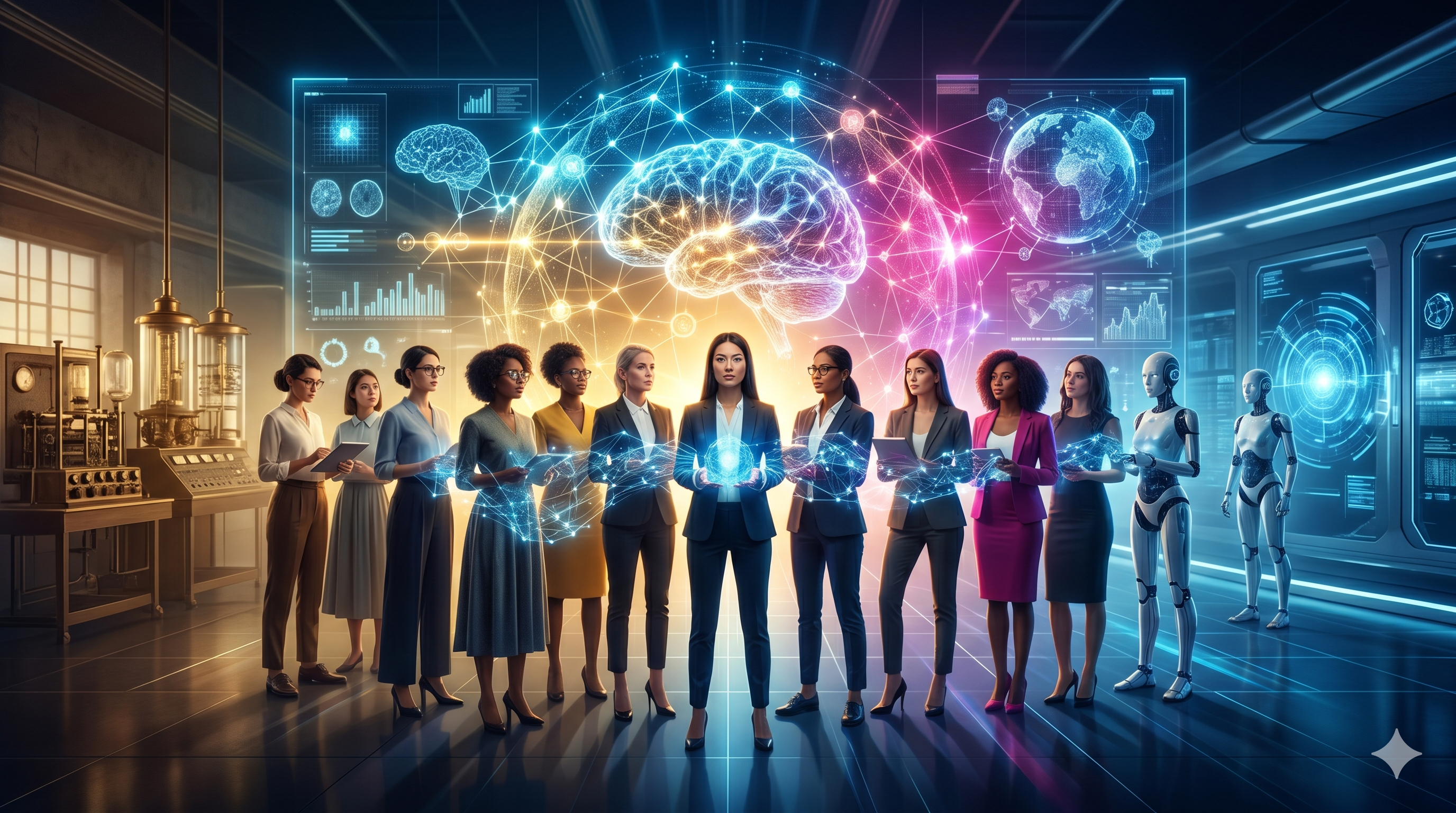
The Force That Is Reshaping the Digital World
Women in technology are no longer an emerging story — they are the story. From writing the first algorithms to leading billion-dollar enterprises, their contributions have been foundational, transformative, and only growing in magnitude.
28% of global tech workforce are women | 3× more innovative outcomes in diverse teams | $12T potential GDP gain from gender parity in tech |
A Legacy Written in Code
Long before technology became a cultural conversation, women were at its very heart. Ada Lovelace envisioned computing as a universal science in the 1840s. Grace Hopper invented the first compiler and coined the term "debugging." The women of NASA — Katherine Johnson, Dorothy Vaughan, Mary Jackson — hand-calculated trajectories that sent astronauts to the moon. These were not supporting roles. These were the defining acts of a technological civilisation.
That legacy continues today. Women now lead some of the world's most influential technology organisations and research labs — driving breakthroughs in artificial intelligence, biotechnology, cybersecurity, and climate tech. Their presence is not incidental; it is architecturally significant.
What Women Bring That Changes Everything
Research consistently shows that gender-diverse teams produce more creative solutions, make fewer systemic errors, and build products that serve broader populations. The reason is not mysterious — it is structural. Women, who make up over 50% of technology's end users, bring lived experience that shapes more empathetic, accessible, and inclusive design. When they are in the room, the questions being asked fundamentally change.
"Diversity is not a checkbox — it is the mechanism by which technology avoids building the world for only half of it."
Women in tech also demonstrate a distinct approach to leadership: collaborative, long-horizon thinking, and a higher tolerance for systemic complexity. Studies in Silicon Valley and beyond show female-founded startups generate 35% higher returns on investment, and companies with women in senior technical roles report stronger retention, fewer product recalls, and greater user satisfaction scores.
The Differentiator in an AI-First Era
As artificial intelligence reshapes every sector, the stakes of representation in tech have never been higher. Algorithms trained on biased data produce biased outcomes — in hiring, healthcare, criminal justice, and lending. Women working in AI and data science are among the most vocal advocates for ethical AI frameworks, transparency standards, and bias auditing. Pioneers like Fei-Fei Li at Stanford's Human-Centered AI Institute are fundamentally redefining what "intelligent" should mean in the context of human values.
Beyond ethics, women are disproportionately driving impact in purpose-driven tech — health tech, edtech, climate technology, and financial inclusion. These are not niche verticals; they are the next decade's most consequential industries. Women are not just participating in this shift — in many cases, they are leading it.
What the Future Holds
The trajectory is pointing upward, but the work is far from done. Globally, initiatives like Girls Who Code, STEMinist programmes, and government-backed STEM scholarships are steadily closing the pipeline gap. More universities are reporting gender parity in computer science enrolment than ever before. Corporate return-to-work and mentorship programmes are retaining women who previously exited the industry mid-career.
The future of technology will be built on data, creativity, and moral intelligence — all areas where women have historically excelled when given the opportunity. The organisations and nations that accelerate this transition will not just be more equitable; they will be more competitive, more innovative, and better positioned to solve the defining problems of our time.
The digital revolution does not belong to any one gender. But it cannot reach its full potential without all of them.
List of Comments
Leave a Comment