
People ARE the Strategy. Lets Own It.
People ‘ARE’ the Strategy. Let's Own It.
There is a quiet revolution happening in organizations around the world, and most HR functions are either leading it or being left behind by it. The next decade will not be won by the company with the most sophisticated technology stack, the biggest marketing budget, or even the strongest balance sheet. It will be won by organizations that make a fundamental decision — a decision to treat human capability as a strategic asset, not an administrative cost. And the HR function that chooses to step into that reality, boldly and deliberately, will be the one that helps its organization win.
I say this not as a textbook idea. I say it from where I stand every single day — in the thick of the work, wrestling with real problems, watching initiatives succeed and stumble. The role of HR must shift. Not slightly. Fundamentally. We must move from being the function that manages people to the function that builds the enterprise's capacity to win — through leadership development, skills infrastructure, AI integration, and a culture that actually drives performance. That is the thesis. That is the challenge. And that is the opportunity.
Good Intentions Are Not Enough
Let me have my moment at my constant rant, The phrase "HR is a strategic asset, not an administrative cost" has been said so many times at so many conferences that it has almost lost its meaning. I have sat in rooms where HR leaders delivered beautifully crafted presentations about people strategy, only to walk back to their desks and spend the rest of the week processing leave applications, Development plans and chasing performance review compliance. The words are right. The actions have not always followed.
Saying it is not enough. We have to build it. We have to demonstrate, with evidence and outcomes, that the HR function is genuinely capable of contributing to the enterprise goals of the organization — not just supporting them from the sidelines, but actively shaping them.
So what does that actually look like? What should HR be doing to build capabilities that help organizations meet their objectives?
The Talent Problem Is Not What We Think It Is
Let me tell you about a problem I deal with constantly — hiring in the construction industry. If you have ever tried to recruit skilled tradespeople, Estimators, Project managers, or site supervisors in today's market, you know the frustration intimately. You post the job. The applications that come in are either wildly underqualified or from people whose skills belong to a version of the industry that no longer quite exists. The talent pool feels shallow, and the pipeline feels broken.
But here is what I have come to understand after years of being in this space: the problem is not that people are hard to find. The problem is that the skills companies need today are no longer aligned with the available labor supply. This is a structural problem, not a cyclical one. And if we keep treating it like a recruitment problem, we will keep getting recruitment results — which is to say, disappointing ones.
This realization changed how I think about talent strategy entirely. Skills forecasting, internal mobility, Capability development and accurate workforce data — these are not optional tools for large enterprises with sophisticated HR teams. They are essential for any organization serious about building a sustainable workforce. Yet they remain criminally underused.
Retention has become the new recruitment. The cost of replacing a skilled worker in construction — when you factor in lost productivity, onboarding time, and the tribal knowledge that walks out the door — is enormous. So instead of obsessing only over who we can bring in, we must obsess equally over how we develop, grow, and redeploy the people already with us. Internal mobility, done well, keeps your best people engaged and growing. Skills forecasting tells you where the gaps are coming before they become crises. Together, they form the foundation of a proactive workforce strategy rather than a reactive one.
HR's Own Operating Model Has to Change
Here is another truth I have come to sit with: the way most HR functions are structured today was not designed to solve the problems organizations face tomorrow.
According to research from TMI, 89% of HR functions have already been restructured or are planning to do so within the next two years. That is not a coincidence. That is a signal. The traditional HR model — built around compliance, administration, and functional silos — simply cannot carry the weight of what organizations now need from their people function.
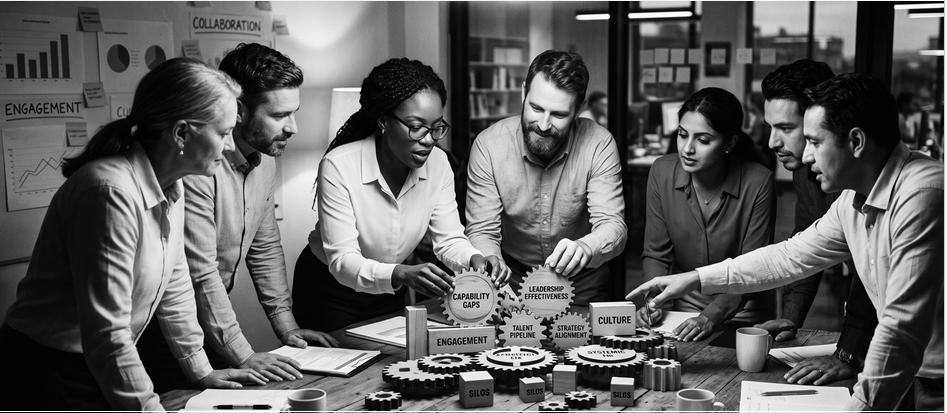
Josh Bersin — one of the most insightful voices in the HR and learning and development space globally and someone who is used to diligently follow in my Learning and Development profile at a Bank — has written compellingly about this shift. In his work on what he calls "Systemic HR," Bersin argues that the future of HR is not about being a better version of what we already are. It is about becoming something fundamentally different: a consulting-oriented function that solves enterprise-wide problems, not just HR domain problems. His premise is that HR's real problems — engagement, capability gaps, leadership effectiveness, culture — cannot be solved by one HR sub-function working in isolation. They require integrated thinking, shared accountability, and a genuine understanding of the business.
I find this framing deeply compelling. When HR starts thinking and operating like an internal consulting firm — asking "what business problem are we solving?" before designing any initiative — something shifts. We stop being reactive and start being relevant. We stop measuring inputs and start measuring impact. And once we are genuinely solving enterprise problems, not just HR problems, we have earned the right to call ourselves a strategic function. Not before.
Start With Leadership — It Has the Highest Multiplier Effect
Once we accept that HR's job is to build organizational capability, the next question is where to focus first. My answer, every time, is leadership.
Here is the logic: leaders are responsible for driving organizational performance through their teams. If you develop a leader well, you are not just developing one person — you are improving the performance environment for every person that leader touches. The multiplier effect is real and it is significant. Research consistently shows that organizations with strong leadership are more than twice as likely to excel at innovation. The correlation between leadership quality and business outcomes is not soft — it shows up in revenue, retention, customer satisfaction, and ultimately in enterprise value.
What leadership development needs to look like in the next decade, however, is quite different from the traditional model of sending managers to a three-day workshop and hoping for the best. Leadership development is becoming more practical and execution-focused. The leaders who will carry organizations through the next decade are not those who can articulate a leadership framework in a classroom — they are the ones who can handle genuine ambiguity, make clear decisions under pressure, sustain team performance through relentless change, and bring their people with them through uncertainty. Those capabilities are built through experience, feedback, coaching, and deliberate development — not through abstract models alone.
This is where HR has the most direct line to bottom-line impact, and we should be pursuing it with far more urgency than we currently do.
And Then There Is AI — The Force That Changes Everything
Now, let us talk about the elephant in every boardroom: artificial intelligence. I want to be honest about something. I am not a technology evangelist. I do not believe AI solves everything. But I do believe that HR functions that ignore it, or treat it as someone else's responsibility, will be leaving extraordinary value on the table.
Honestly, AI excites me. Not because of the hype around it, but because of what it genuinely makes possible for those of us who have spent years trying to do more with less in the people space.
Think about it. For the first time, we have tools that can tell us where our workforce gaps are before they become crises. We can make smarter internal mobility decisions because we finally have the skills data to back them up. We can identify which leadership behaviours are actually moving the needle on team performance — not guess at them. We can make learning a daily habit rather than an annual event. That is not a small thing. That is transformational, if we choose to use it that way.
And here is what really gets me energised: AI is not just an IT conversation or a finance conversation. At its core, embedding AI into how an organisation makes decisions, plans its workforce, and delivers value — that is a deeply human endeavour. It needs alignment between HR, operations, finance and leadership. It needs trust, governance, and a genuine understanding of people and culture. That is our wheelhouse. That has always been our wheelhouse.
So rather than waiting to be invited into the AI conversation, I think HR should be walking through the door. We are the ones who understand what the organisation is actually capable of. We know the culture, the people, the gaps, and the potential. Pair that with the analytical power AI now puts in our hands, and we are not just participants in the strategy we are architects of it. That opportunity does not come around often. I for one do not intend to miss it.
The Decade Belongs to Those Who Choose to Lead
I want to end with this. We are at an inflection point. The organizations that decide — right now — to treat their people as their primary competitive advantage will look back on this moment as the turning point. The ones that hesitate, that keep HR in its traditional lane, that wait for proof before committing to capability building, will find themselves playing catch-up in a race that does not slow down for stragglers.
As HR professionals, we have a choice. We can sit on the sidelines and complain that we are not given a seat at the table, or we can build something so valuable that the table comes to us. We can write reports about the importance of talent, or we can go build the talent pipelines that keep our organizations moving. We can talk about culture, or we can engineer the conditions in which great culture actually thrives.
The next decade will be won by the bold, the intentional, and the relentlessly capability-focused. And HR — real HR, strategic HR, systemic HR — has every tool it needs to lead that charge.
So stop waiting for permission.
“The HR professionals who will shape the next decade are not the ones who complained loudest about not having a seat at the table — they are the ones who were too busy building something worth sitting down for. Let’s not mourn the gap between where HR is and where it needs to be. Together ...Lets Close it.”
List of Comments
Leave a Comment