
Human-Centric and Agile Leadership
When We Invest in People, We Unlock the Energy That Makes Organizations Unstoppable
(A Human-Centric and Agile Leadership Perspective)
“Start with the end in mind.” — Stephen Covey
If we begin with the end in mind — the “end” being a thriving, resilient, and future-ready organization — then the path to get there has never been clearer: people are the strategy.
For years, organizations poured effort into “culture fit,” perks, and employee engagement activities — pizza Fridays, ping-pong tables, and themed Zoom backgrounds. It worked for a while. But this generation of employees is quietly asking for something deeper.
They want to be understood. They want their companies to “get them.”
They’re no longer motivated by perks alone. What they seek instead is purpose, adaptability, and trust — the core ingredients of human-centric and agile leadership.
The Shift: From merely focusing on building the Culture to actually making a Connection
The corporate landscape is evolving faster than most of us can keep up with. Artificial intelligence is reshaping jobs. Hybrid work is rewriting old rules. The pace of change is relentless — and in that whirlwind, employees want one thing: to feel relevant, empowered, and seen. As HR it should be our endeavour to ensure that all our employees feel relevant.
Gone are the days when engagement was measured by how many people showed up at the annual company gathering. Employees today crave a workplace that adapts as quickly as they do — one that supports them as learners, thinkers, and humans.
My personal experience is that People don’t leave companies because they’re tired of working hard — they leave because the work no longer feels meaningful.
Or worse still driven employees leave when they cease to feel their work is making the impact and that’s the truth of it.
When employees stop feeling challenged or relevant, they don’t just disengage — they fade. They go through the motions, lose creativity, and their productivity quietly erodes. But when organizations invest in keeping people connected to purpose and growth, everything changes.
Rethinking What It Means to “Invest in People”
It’s true that when we invest in people, we unlock the energy, creativity, and resilience that make our organization unstoppable.
But let’s be clear: investing in people doesn’t only mean sending them to a training course or checking off a “learning” KPI. It’s much broader — it’s about building a system where people can do their best work.
It means enabling internal mobility, so employees see a future with you.
It means creating clear career pathing frameworks, so ambition finds direction.
It means improving the employee experience — from digital tools to daily interactions.
It means maintaining open communication, where people know their voices matter.
And yes, it means digital enablement — giving employees tools and automations that make work smoother, faster, and more empowering.
Because here’s what I believe:
“A productive workforce makes for a happy workforce — not the other way around.”
We’ve long believed that happy employees are productive employees and that’s why the ongoing tirade of engagement activities seemed they right thing to do. I would much rather provide the supports employees need than cram the employee engagement calendar with activities in the hope that it would make for happy employees.
The reality has flipped. I sincerely resonate with the fact that when we enable employees to thrive — through meaningful work and improvement projects , support systems, and clarity — they become both happy and high-performing and That’s the foundation of human-centric and agile leadership.
The Changing Corporate Landscape
Let’s face it — today’s business environment is unpredictable. Technology cycles shorten by the year. Market expectations shift overnight. Skills that were relevant yesterday may not be tomorrow.
Every employee feels that pressure to stay relevant. When they stop learning or growing, they don’t just stagnate — they disengage.
Boredom creeps in. Purpose fades. Productivity drops.
But what if, instead of fearing that change, organizations leaned into it? What if we said: “Let’s help our employees adapt with us — not to us”?
That’s where agile leadership comes in. Agile leaders don’t resist change; they harness it. They create environments where flexibility and collaboration thrive.
Agile leadership in practice looks like this:
- Flexibility: Adapting to change instead of resisting it.
- Empowered teams: Leaders act as enablers, not controllers.
- Continuous feedback: Reflection and course correction are routine.
- Transparency: Clear communication and shared accountability.
- Learning mindset: Experimentation is encouraged, and failure is treated as data, not defeat.
Picture this: an agile leader opens a short morning stand-up. The conversation isn’t about what went wrong, but what’s blocking the team and how to remove it. Small tweaks, quick adjustments, constant alignment. The focus is on progress, not perfection. One frequent question our respective teams often ask ourselves in our PDCA meetings when things have not panned out as planned is “what got in the way”.
That’s not just a management style — it’s what employees are quietly asking for. They want leadership that listens, adjusts, and trusts. Not a long leadership alignment spiel, but a genuine connection to how work gets done and why it matters.
Starting at the Bottom: Building Around People
Human-centric leadership starts at the ground level — with understanding.
Simply put:
“Human-centric leadership starts by understanding what people need to do their best work — and building everything else around that.”
That means putting empathy before efficiency, listening before deciding, and designing work systems that revolve around human capability, not bureaucracy.
Empathy is the cornerstone. It’s about knowing what drives people — their challenges, motivations, and fears — and acting on that understanding. When leaders listen with intent, employees respond with trust.
And that’s how you get the best of both worlds: human connection and business agility.
The Best of Both Worlds: Empathy Meets Agility
While Edward Deming did well to quote “In god we trust, all others bring data” a great decision-making tool on business no doubt. For me, however, it serves as a reminder that having data is not the same as knowing how to use it. And while the quote promotes a culture that listens to data, we must not forget that the most successful modern leaders combine heart and mind — empathy and data.
They:
- Lead with empathy and data. Empathy helps us understand people’s experiences. Data helps us act on them intelligently. Without data, empathy can feel like intuition; without empathy, data feels cold. Together, they drive better decisions.
- Use coaching instead of command-and-control. Coaching empowers. It turns mistakes into lessons and leaders into guides.
- Encourage learning cycles and celebrate small wins. Because growth doesn’t come from perfection — it comes from iteration.
- Prioritize inclusion, trust, and psychological safety during change. People need to feel safe to contribute ideas, even imperfect ones. Relevance isn’t given; it’s cultivated through belonging.
- Focus on outcomes, not rigid processes. Agile leaders blame the process, not the people. They adjust systems, not spirits.
And when these principles take root, workplaces transform. Employees don’t just show up — they show up fully.
What they really want:
When you strip away the buzzwords, what employees want today is surprisingly simple:
- To be trusted.
- To have purpose.
- To keep learning.
- To feel that their work matters.
- To know that leadership “gets” them.
They want the same personalized experience they get as consumers — tailored, responsive, and meaningful.
And when organizations design their workflows around the employee experience, loyalty follows. Not forced loyalty born from contracts or perks, but earned loyalty born from mutual respect.
Way back one employee once told me after a team meeting,
“I don’t need grand gestures from my company. I just need to feel that someone’s paying attention to what helps me do great work.”
I thought to myself, That’s it. That’s the whole game.
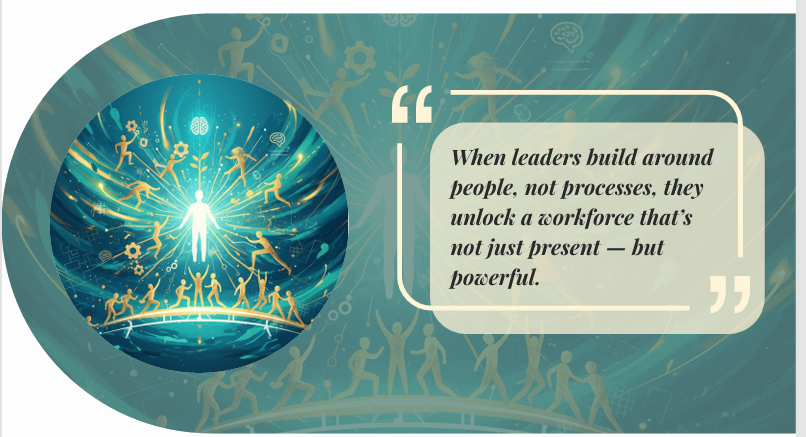
When we design for humans — not hierarchies — we win their trust. When we adapt like agile teams, we keep their engagement. And when we combine the two, we create a workforce that’s not only productive but unstoppable.
Why It Matters Now More Than Ever
Organizations are realizing that human-centric and agile leadership isn’t a trend — it’s survival.
In times of uncertainty, people look to their leaders for clarity and confidence. The ones who thrive are those who create environments where people can adapt, learn, and lead from every level.
Because adaptability isn’t built into systems — it’s built into people.
When we equip our workforce with empathy, flexibility, digital fluency, and trust, they respond with innovation, loyalty, and resilience.
And that’s how organizations not only stay in business — they lead it.
The Future Belongs to the Human-Centric and Agile Leader
The leaders who will define the next decade are those who understand that the future of business is human.
They know that purpose fuels productivity.
That flexibility breeds innovation.
And that trust is the new currency of performance.
Because at the end of the day, leadership isn’t about control — it’s about connection.
Or as a senior leader in one of my previous organizations once put it after seeing his team rally through a difficult project:
“It wasn’t my direction that made it happen. It was their belief that I believed in them.”
That’s the heart of it.
My closing thought therefore is that Human-Centric and Agile Leadership isn’t a nice-to-have; it’s the only way forward. Because if we truly want to build organizations that last — through disruption, transformation, and reinvention — we have to start with what never changes: people.
“Human-Centric & Agile Leadership is not just good for business — it’s critical to stay in business.”
List of Comments
Leave a Comment