
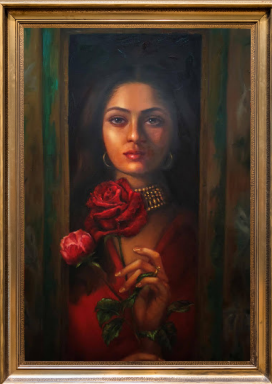
Crossing the threshold
I stood outside the class, in the courtyard, my mind on two things at once – the vulture flying low though not ominously, and the muffled words of the teacher. Her soft tones were in stark contrast to the knife-like precision with which she had cut through me a while ago, ordering me to leave. The vulture perched on the roof eyeing me – as a fellow comrade. After all, I met them every day as our home was close to the cremation ground. My family handled the cremation of the three villages that were close by. They feasted on left-over carcasses; the scavengers of the bird kingdom. Death was a way of life, for us and them.
‘Dalit andar nahin ayenge.’ The teacher had said viciously.
Eight years old, I had heard the term earlier. I had a fuzzy idea it meant that I could not play with my classmates. Nor could I enter the temple… it was a bunch of not-allowed things. My appearance was not vastly different from the other children. Except my eyes. Maybe the almighty was in a playful mood when he gave color to them. I ate the same food. The water that nourished their bodies, also nourished mine. When I was forbidden to use the glass next to the water pitcher, I looked at my hands, puzzled. They were clean.
A sharp pain cut through my thoughts as the teacher’s wooden scale landed on my shoulder. I jumped back to save myself. My little feet could not match the bigger ones. The sharp edge of the wood landed on my back again and again till I could yelp no more. I felt the blood trickle down my legs. The wall swayed in front of my eyes and then the cool and welcome darkness caressed me.
I woke up at home to see my lovely mother’s concerned eyes. For a split second, her emotion naked and raw. She concealed it quickly. I wondered why? As I had wondered about many things to do with her. She took pains to look plain and dress without ornaments, especially when we went out.
“Who… are the Dalits?” I mumbled. “Are we different in any way? Why do people call us dirty?”
She shrugged wearily. “We are the people of God… Harijans. It is what it is.” Her lips quivered as she said it. With finality.
I looked out at the cremation ground from the verandah of our home. There were two skies. The smoky reddish dark haze of what was left of the burnt bodies and the evening blue- grey sky above it. I squinted to see the boundary, but I couldn’t make out where they separated; like two notes held together until they became a single harmony.
Standing outside the class while the other students studied indoors, became a way of life for me. At some point, I started to feel sorry for them. In any case, my teachers were everywhere I looked. The lush trees, the blooming flowers, the birds of prey and the birds that sung, all taught me the unseen laws of life and death. My mind was sharp and my grades good. I was happy.
Happy, until the day my mother passed.
I could not get up from the bed. I heard my father and brother mumbling about some fever as I drifted back and forth into the comforting pit of darkness. Grey shapes. I could not see or taste the food handed over to me on the cot. “So, this is what death is like”, I thought to myself. A slow movement toward the cool and sparkling void. I wasn’t afraid. I would be with my mother soon.
And then, I awoke.
With difficulty, I focussed on the figure in front of me… a lady in a white coat. She smiled and patted me on my head as if to reassure me that everything was all right. The experience was alien and scary, yet pleasurable in a way. I recoiled in alarm. “I am a Dalit… untouchable.”
She stared at me and gave me a perplexed look. The empathy stirred within me an emotion I could not fathom. I tasted the warm salt of my tears. Was it gratitude or had her simple act touched a part of my soul that I had buried long ago?
“I am Dr Mina” she smiled.
I recovered rapidly under her care and kindness. In one of our meetings, I opened my file with a flourish. It was my treasure. My drawings. They were detailed sketches of all the creatures and plants around the village. They had been my only companions for years. Only, instead of heartfelt conversations, they revealed themselves to me in other ways. I had captured that in the form of elaborate illustrations. Dr Mina turned the pages slowly, savouring them till she reached the very end.
“These are amazing,” she said softly. “Mauli, have you ever thought of being a Doctor?”
“Dr. Mauli… Dr. Mauli” My recollections interrupted, I turned to see Mr. Gupta’s assistant. He had just arrived at my home.
“Mr. Gupta is waiting for you to discuss the new clinic that has to be set up.” He had a handkerchief held to his mouth. “How do you stay here…. So close to the cremation ground?”
It was the same question I had asked myself when I returned as a doctor, to my village.
Perhaps, the burial grounds welcomed everyone into her fold – her heart large enough to accommodate the infinite man-made illusion of diversity. Perhaps, because in life, we are constantly becoming death. Every moment lived is a small ending, a rehearsal of death. Life excited me, but death did not scare me. I had lived and surrendered to a thousand deaths. Every taunt flung at my so-called status as Dalit was exactly that. But life, birds, animals, plants, had all asked me to begin again and again, even when I was surrounded by endings. For every unkind gesture I experienced, the memory of Dr Mina’s kindness renewed me. For as long as I could remember, she had stood beside me – my mentor.
I crossed the threshold with quick steps; as I had done earlier. Quotas, derision, heckling, forms and files… they had all been my companions in the journey from Mauli the dalit, to Mauli the doctor.
Leadership Lesson
Dr Mauli did not merely cross barriers. She made them visible, so that others could cross them faster. That is what transformed her journey from personal resilience to collective progress.
She was told early in life ‘Stay within the lines drawn for you’.
What changed her trajectory was the intervention of the right mentor at a critical juncture. A mentor who saw her through the lens of possibility rather than identity.
Leading organizations evolve by recognising that many traditions or submissions are meant to be broken, especially if they exclude. Inclusion is not a policy; it is a continuous movement to make people belong. It is lived in who gets access and who gets seen. This can happen only by setting designs and structures for the same.
In the process of inclusion itself, many new voices with new ideas, create new leaders.
An arrow that is pulled back in tension, has a quiet decisive release. Just as those that have been marginalized in the past, are hungry to contribute and finally cross the invisible threshold.
List of Comments
Leave a Comment