
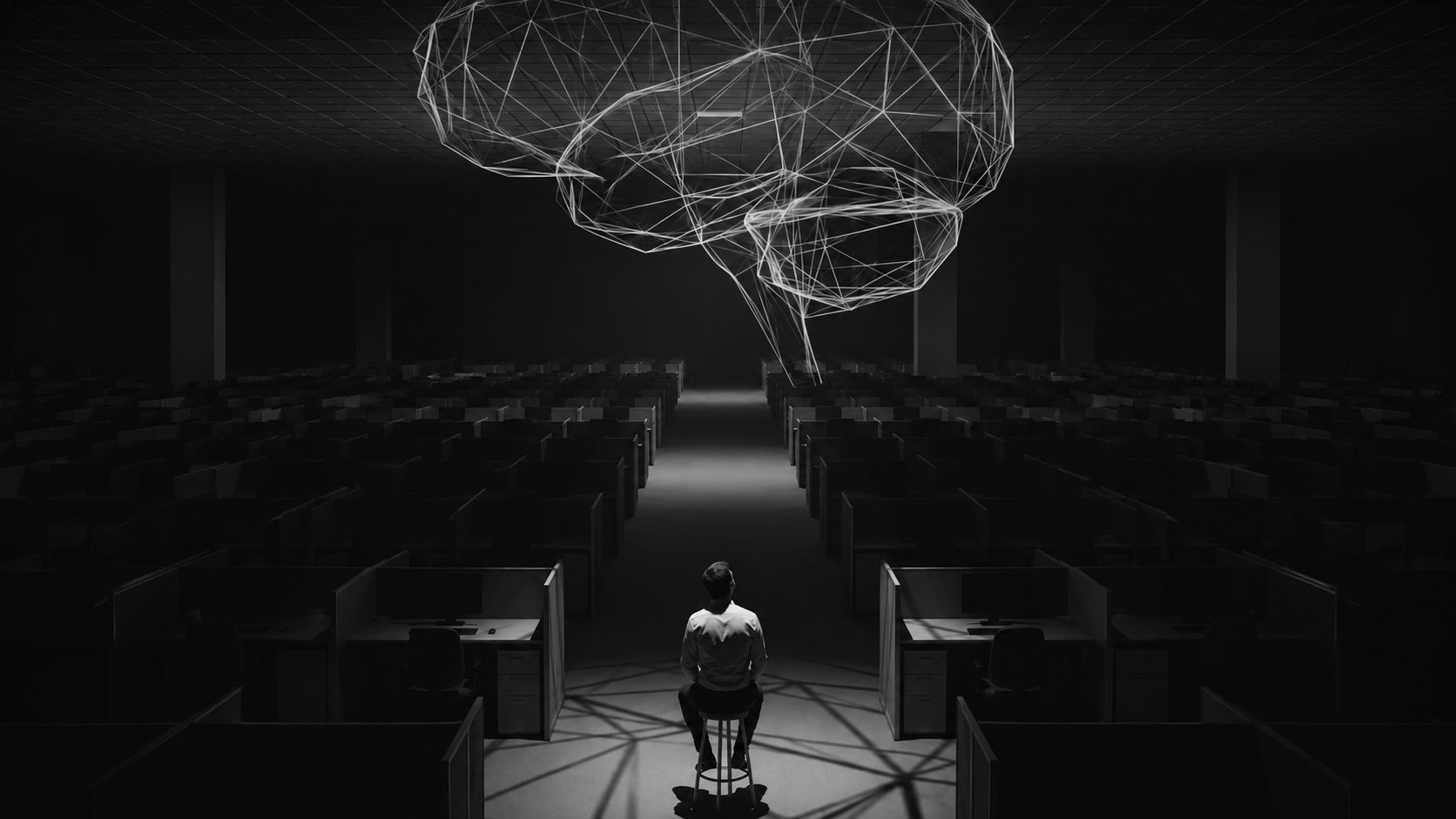
Am I Still Relevant
Am I Still Relevant?
The Human Identity Crisis at Work in the Age of AI
When did you last lie awake wondering if a machine could do your job better than you?
If you have - you are not alone. According to a 2024 McKinsey Global Survey, nearly 40% of workers across industries reported moderate to high anxiety about AI displacing their roles within the next three years. But here is the number that should stop every business leader and HR professional cold: the same study found that only 18% of organisations had a structured plan to address that anxiety. We are, in other words, watching a crisis unfold in slow motion and doing very little about it.
This is the first in a series of columns on People Matters. Not HR policy. Not talent strategy frameworks. People. The messy, complicated, deeply human beings who show up every day and make organisations what they are. And right now, many of those people are quietly asking a question that no performance review, no town hall, and no AI adoption roadmap is answering:
Am I still relevant?
The Question Beneath the Question
Let us be precise about what this question really means. It is not just about job security, though that fear is real and valid. It is something deeper. It is about identity.
For most professionals, work is not merely what they do for a living. It is who they are. The doctor, the designer, the data analyst, these are not job titles. They are self-concepts, built over years of education, effort, and earned expertise. When AI arrives and begins to replicate and sometimes surpass the very skills that defined a person's professional worth, it does not just threaten their livelihood. It destabilises their sense of self, the identity they have built over the years.
This is the identity crisis that the modern workplace is not yet equipped to handle. We have built onboarding programmes, learning management systems, and competency frameworks. We have not built the language or the safe space to say to an employee: 'I know this feels like the ground is shifting beneath your feet. Let us talk about that.'
You cannot upskill your way out of an existential crisis.
The Anxiety Is Rational — Not Irrational
One of the most damaging things leaders and HR professionals do often with the best intentions, is dismiss AI anxiety as unfounded. 'Don't worry, AI will create more jobs than it destroys.' 'You can't be replaced; you're a people person.' 'The machines need humans to run them.'
These reassurances, however well-meaning, are patronising. They signal to the employee that their concern is not worth engaging with seriously. And worse, they may not be entirely true.
The truth is more nuanced, and more honest leaders are starting to admit it. Yes, AI will create new roles. But those roles will not automatically go to the people whose current roles disappear. The lawyer who spent twenty years mastering contract review is not, by default, going to become a prompt engineer or an AI ethics consultant. The transition is real, it is hard, and it requires far more than a two-day reskilling workshop.
Acknowledging this is not pessimism. It is respect. And respect, it turns out, is the foundation of every meaningful conversation about change.
The most dangerous thing you can tell an anxious employee is that they have nothing to worry about.
What AI Is Actually Doing to the Human Mind at Work
Beyond the macro-level disruption, there is a subtler psychological toll that deserves attention. Consider what happens when a professional uses an AI tool that does in thirty seconds what used to take them three hours. The rational response is relief. The human response is often something more complicated: a quiet unease, a diminishing of pride, a whisper that asks if the machine can do this, what exactly was I contributing all along?
Psychologists call this cognitive dissonance. We know intellectually that efficiency is good. But emotionally, we derive meaning from the effort we invest in our work. When that effort is suddenly bypassed, the meaning does not automatically transfer to the outcome. It evaporates.
There is another serious risk we run of losing our very cognitive ability of thinking and acting deeper as AI will gradually spoil everyone and steal them of this beautiful trait that Humans are born with. Studies found a significant negative correlation between frequent AI usage and critical thinking, as users depend on automated solutions rather than engaging in deep, independent thought.
This is not a technology problem. It is a human problem. And it will not be solved by better AI tools or faster internet connections. It will be solved by organisations that take seriously the need to help people reconstruct their sense of value and contribution in a world where the definition of 'work' is changing faster than any of us anticipated.
What Leaders Must Stop Doing — And Start Doing
Stop holding town halls that celebrate AI adoption without acknowledging the human cost. Stop publishing AI strategy documents that are heavy on capability and silent on people. Stop measuring the success of digital transformation by speed of implementation, when the real measure should be the health and confidence of your workforce through the transition.
Start having the honest conversations. Not the scripted ones, the real ones, where a leader sits with a team and says: 'I do not have all the answers. Some of what we do will change significantly. And I am committed to navigating that with you, not around you.'
Start investing in identity resilience not just skill resilience. Help your people articulate what makes them irreplaceably human: their judgment, their empathy, their context, their relationships, their creativity, their ethics. These are not soft skills. In the age of AI, they are your organisation's hardest competitive assets.
The organisations that will win are not those who automate the fastest. They are those who humanise the deepest.
The Question Leaders Must Ask Themselves
Before we close, a challenge directed not at employees, but at the people who lead them.
When did you last feel irrelevant? When did you last sit with the discomfort of not knowing whether your own instincts, your own experience, your own way of doing things still mattered in a world that seems to be rewriting its rules by the quarter?
If you have felt it, even fleetingly, then you already understand what millions of people across your organisation are feeling right now often silently, often alone, often while smiling through your all-hands meetings.
The question 'Am I still relevant?' is not a weakness. It is the most honest professional question a human being can ask in this moment. Your job as a leader is not to silence it with reassurance. It is to sit with it, honour it and then help your people find their own, grounded, authentic answer.
List of Comments
Leave a Comment